

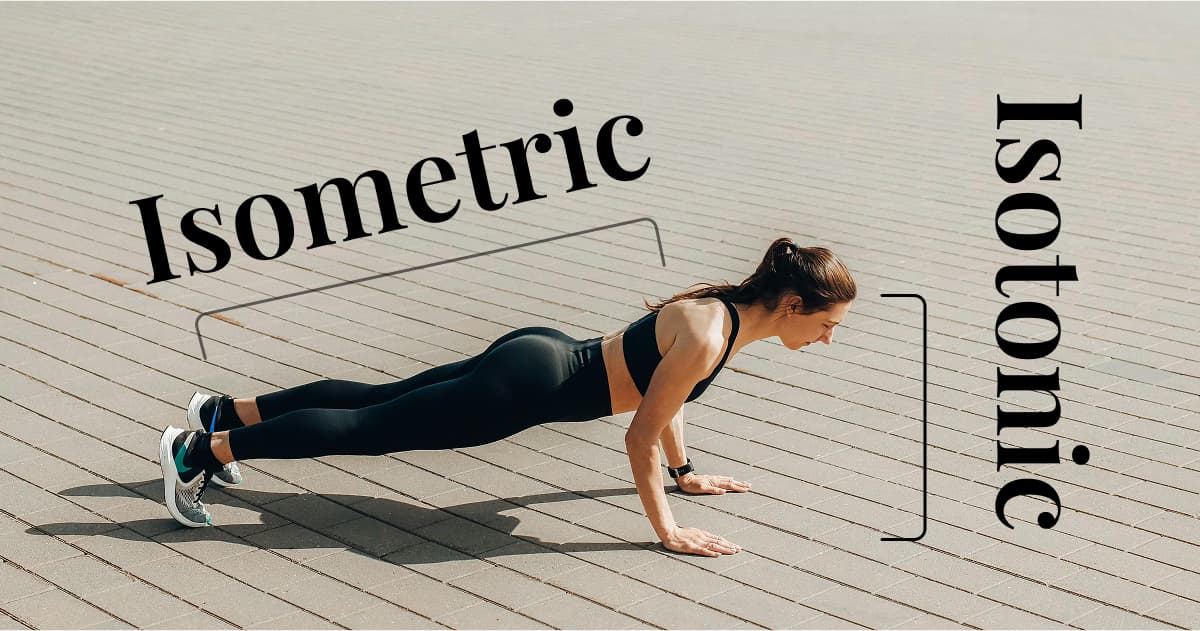
Isometric vs. Isotonic Exercises: Understanding the Difference
Isometric and isotonic exercises are two common ways to train muscular force, distinguished mainly by whether the joint moves during the effort.
- Isometric Exercise features static contraction where the muscle tenses without changing length. Think: planks, wall-sits, and yoga poses like tree pose.
- Isotonic Exercise involves muscle contraction with movement. The muscle changes length (shortening or lengthening) while under load. Think: bicep curls, squats, running, and swimming.
Key Takeaways
- Isometric exercises create tension with little or no joint movement; planks, wall-sits, and static holds are common examples. See the guide to isometric training for definitions and beginner examples.
- Isotonic exercises move a joint through a range of motion; squats, push-ups, and curls are familiar examples.
- Isometrics can build or measure force at specific positions, while isotonic work trains movement through a broader range. For testing terminology, see the maximum voluntary contraction (MVC) guide.
- Neither type is universally better. The appropriate choice depends on your goal, experience, symptoms, and, during rehabilitation, professional guidance.
Key Differences at a Glance
| Feature | Isotonic | Isometric |
|---|---|---|
| Movement | Yes (dynamic range of motion) | No (static position) |
| Muscle Length | Changes (shortens/lengthens) | Constant |
| Resistance | Constant tension | Constant length |
| Examples | Push-ups, squats, cycling | Planks, wall-sits, static lunges |
| Sensation | Rhythmic movement | Sustained muscle burn |
Both can support strength training, but in different ways. Isotonic exercises train force through movement, while isometrics emphasize force at specific joint angles.
Benefits of Isotonic Exercise
Muscle Strength & Hypertrophy
Dynamic resistance training can support muscle growth and strength gains Azeem & Zemková, 2022.
Functional Performance
It resembles daily tasks like lifting, walking, and climbing and can help train mobility, power, and athletic skills.
Endurance & Cardiovascular Health
Higher-repetition movements can train muscular endurance and, when performed at sufficient intensity, contribute to aerobic conditioning.
Flexibility & Joint Mobility
Moving through an appropriate range can help maintain joint mobility and flexibility.
Bone Density
Weight-bearing isotonic exercises (e.g., squats) can provide a stimulus for bone remodeling as part of an appropriately designed program.
Coordination & Skill
Movement-based practice can help develop neuromuscular coordination and balance.
Benefits of Isometric Exercise
Static Strength & Joint Stability
Reinforces strength at specific angles—useful for posture, bracing, and real-life force-hold situations Mountain Tactical Institute, 2020.
Joint-Friendly Strength Training
Isometric exercise can be performed with little joint movement and may be useful in some rehabilitation or joint-sensitive contexts. If you have pain, arthritis, or another medical condition, follow guidance from a qualified healthcare professional Healthline, 2020.
Pain Reduction
Some research has reported short-term pain changes after isometric contractions in specific conditions, such as patellar tendinopathy. This is not a reason to train through pain; seek professional advice for persistent or worsening symptoms Rio et al., 2015.
Postural Endurance
Can train the endurance of core and stabilizer muscles, supporting posture and movement control.
Blood Pressure Reduction
Isometric exercise has been studied for its potential role in blood-pressure management Edwards et al., 2023. If you have high blood pressure, cardiovascular disease, or take related medication, consult a qualified healthcare professional before beginning intense isometric training.
Convenience & Accessibility
Many isometric exercises require no equipment, making them practical for short workouts or limited spaces.
When and How to Use Each
- For Muscle Mass & Power: Prioritize isotonic training.
- For Stability, Position Control, or Low-Movement Training: Consider isometric exercises.
- In Rehabilitation: A professional may use isometrics and later introduce isotonic movement, depending on the condition and stage of recovery.
- For Athletic Performance: Blend both—dynamic isotonic moves for power, isometrics for position holding and control.
- For Busy Schedules: Combine quick isotonic circuits with isometric finishers.
Real-World Applications Across Industries
1. Healthcare & Rehabilitation
- Isometrics may help maintain muscle activity when movement is limited.
- Isotonics may help rebuild movement and function as recovery progresses.
- For chronic pain, arthritis, or post-operative rehabilitation, exercise selection and progression should be guided by a qualified professional Rostami et al., 2022.
2. Education & Youth PE
- Planks and wall-sits teach muscle engagement without motion.
- With age-appropriate instruction and intensity, they can help teach posture and core engagement.
3. Workplace Ergonomics
- Some workplace exercise programs include neck isometrics or wall-sits; persistent neck pain or tension warrants appropriate professional assessment O'Riordan, 2014.
- Labor-intensive roles use isotonic lifts and isometric bracing to practice movement and position control under load.
4. Military & Tactical Training
- Combine deadlifts (isotonic) with wall-sits and planks (isometric).
- These combinations can train grip endurance and posture under load Mountain Tactical Institute, 2020.
Combining Both for Balanced Training
Blending isotonic and isometric movements can provide a practical mix of movement-based and position-specific training.
Examples:
- Sports: Pause reps (e.g., squat hold at bottom) build strength throughout the range.
- Pilates/Yoga: Seamless blend of movement and hold for muscle control and endurance.
- HIIT: Pair jump squats (isotonic) with planks (isometric) for variety and effectiveness.
- Rehabilitation: A qualified professional may progress from isometric to isotonic work as appropriate for the individual.
Conclusion: Choosing How to Move and Hold
Many training programs use both isotonic and isometric exercises because they address different needs: movement through a range and force at a position. The right balance depends on the activity, training goal, and individual context.
What Lies Ahead:
- Smart gyms and wearables tracking static force metrics
- Professionally guided exercise programs for blood-pressure management and rehabilitation
- Youth and senior programs combining movement and stability
- Mind-body fitness growth (e.g., isometric breathing holds in yoga)
- Isometric work used to manage load and practice position control
Ultimately, training is not only about moving—it is also about knowing when to move and when to hold. Understanding both exercise types makes it easier to choose an appropriate tool for the task.
